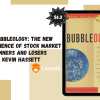
Bubbleology: The New Science of Stock Market Winners and Losers By Kevin Hassett – Instant Download!

Book Description
Investing really comes down to two kinds of stocks: those insulated from bubbles and those that aren’t. Many investors learned this lesson firsthand as the spectacular gains of the Internet era evaporated in a crash.
But what about tomorrow? Can investors tap into the extraordinary profit potential that lies at the frontier of the economy—where innovation and ingenuity thrive—without risking their fortunes? Is there a way to assess price surges and declines and know whether they’re happening for sound reasons or not?
Bubbleology offers exactly that. This insightful and practical guide separates true opportunities from dangerous manias. It overturns the conventional wisdom on bubbles, showing that famous examples like Tulipomania were not bubbles at all.
Traditional risk analysis, which equates volatility with danger, is fundamentally incomplete. Highly innovative companies working to transform the economy naturally operate in uncharted territory, where uncertainty—not necessarily risk—is the norm. Yet pundits and analysts routinely invoke cautionary tales of Tulipomania, the South Sea Bubble, or the dot-com bust to scare investors away from the next wave of innovation. Understanding how ambiguity and incomplete information shape the modern market is essential to capturing future gains. Those who confuse ambiguity with bubbles risk missing the biggest opportunities ahead.
Bubbleology introduces a new way to read what’s really happening in the market. It teaches you how to identify suspicious stocks or sectors, spot real bubbles before they burst, and avoid being swept into speculative frenzies—or scared out of legitimate investments. With its original framework and forward-looking approach, this book helps you evaluate risk more accurately, see through hype, and protect your money while still seizing high-potential opportunities.
Editorial reviews
From The New Yorker
In the wake of the Nasdaq’s precipitate decline, investors who were once boundlessly exuberant are now hopelessly downcast, convinced that the market is doomed to an endless series of boom-and-bust cycles. Adroitly synthesizing work from the fields of economics, evolutionary psychology, and social science, Hassett shows that the kind of frenzy we saw at the height of dot-com mania, far from being characteristic of financial markets, is actually relatively rare. A bubble, he argues, is almost always the product of technological upheaval, which creates great economic potential but also great economic uncertainty. Investors looking for guidance take their cue from each other, encouraging a herd mentality, and individually rational behavior creates a collectively irrational outcome. Still, for all the havoc that bubbles can wreak on our portfolios, they can also provide collective gains: the railroad bubble gave America its first transportation network, and we will be reaping the technological benefits of the Internet boom for decades to come.
Copyright © 2005 The New Yorker
Review
“Financial bubbles are serious business. But in the hands of Kevin Hassett, they’re also a blast. His Bubbleology is as enlightening as it is fun to read.”—Jeffrey H. Birnbaum, Washington, D.C., bureau chief of Fortune magazine and contributor to Fox News Channel
From the Inside Flap
ly two types of stocks: those safe from bubbles and those that are not. This is a fact of investing many discovered as they saw their fabulous gains whittled away by the extreme calamity of the Internet sector.
But what about the future? Is there a way for investors to capture the enormous potential for profit that exists at the frontier of the economy, the place where innovation and genius operate, without placing their fortunes in jeopardy? Is there a way to evaluate price increasesand declinesand identify whether they are happening for good or bad reasons?
Bubbleology makes it possible to separate the winners from the losers. It is a brilliant, practical, and original analysis of the stock market that bashes the conventional wisdom about bubbles, showing that such famous examples as Tulipomania were not, in fact, bubbles at all.
Bubbleology shows that the traditional way of evaluating riskequating it with vola
From the Back Cover
“Financial bubbles are serious business. But in the hands of Kevin Hassett, they’re also a blast. His Bubbleology is as enlightening as it is fun to read.”—Jeffrey H. Birnbaum, Washington, D.C., bureau chief of Fortune magazine and contributor to Fox News Channel
About the Author
Kevin Hassett is a resident scholar at the American Enterprise Institute who formerly served as a senior economist at the Federal Reserve Board. He received his Ph.D. in economics from the University of Pennsylvania. He is the coauthor of Dow 36,000.
Excerpt. © Reprinted by permission. All rights reserved.
Bubbles, Markets, and Frontiers
There are many questions that vex people who study the economy and financial markets. However, the one that uses up the most brainpower is the question of whether financial bubbles exist. A financial bubble is a period when the price of an asset (stocks, real estate, tulips, etc.) suddenly soars for irrational reasons and then collapses. The search is difficult for a simple reason. Price increases are not always bad. Shares of the major pharmaceutical company Amgen, for example, soared more than 1,000 percent in the 1990s as the firm matured from a promising start-up to a profit-making giant. Such an increase made sense given the enormous success of Amgen’s drug-development team. Sometimes stock prices soar and stay high. Sometimes, like the Internet-based stocks, they crash back to earth. It is easy, after the fact, to say that a bubble popped.
The question of whether an asset is increasing in price based on a solid foundation or a chimera is important. Far too many people excuse themselves from participating in the stock market because of an irrational fear of rising prices. These fears are fueled by pundits who abhor every price increase. Sometimes they are right, but often they are not.
For some the search for bubbles has a purely intellectual motivation. Others correctly recognize the tremendous financial potential of a reliable bubble indicator. If you get in on the bubble early and get out just in time, you can make a fortune. Many researchers discussed in this book have devoted themselves to the struggle of defining and discovering bubbles with the focus and the energy that accompanied classic philosophical explorations of far deeper questions. With apologies to the sages, the view of the world emerging from the work on bubbles is at times just as exhilarating as the work of the great philosophers. The search for bubbles has uncovered much more than a window to a quick financial killing.
Because of the possible financial gain, the search for bubbles has been around for centuries, and it has frustrated scientists for just as long. Sir Isaac Newton remarked once, after witnessing the puzzling financial swings of his time, that “I can calculate the motion
of heavenly bodies, but not the madness of people.” Economists began trying to do the latter in the late 1970s, but today they are not alone. As the problems involved in detecting stock market bubbles have become well known, scientists from other disciplines, including psychology, evolutionary biology, mathematics, and theoretical physics, have joined the hunt. Together these men and women have developed a framework that provides a picture of the breeding ground for bubbles. That foundation has helped us understand why bubbles might occur, and, as important, it has provided a new context for organizing our perceptions about the structure of our everyday lives.
What have they learned? The biggest success is that researchers are now asking the right questions. In the hope of getting money out before a financial bubble pops, investors have always wanted to know when a bubble might occur. But far more interesting, it turns out, is the investigation of where they occur. What nooks of the economy are most prone to bubbles? How can the ways people think and interact in specific environments create situations in which strange events can happen?
The search for answers to these questions has been pursued with a heightened sense of urgency in recent years. This is partly because progress has motivated extra effort, but the ideological stakes are high as well. When philosopher Adam Smith wrote The Wealth of Nations in 1776, he laid out a conceptual framework that correctly (at least up to now) predicted the triumph of capitalism. According to Smith, the natural functioning of a free-market system sets prices more efficiently than any other mechanism. How much should an apple cost? By matching supply and demand, the market, as if guided by an invisible hand, finds the right price. When markets function well, the price of everything-even the price of a stock-is set rationally, as if by a giant computer. Almost two hundred years after The Wealth of Nations, Friedrich A. Hayek, Nobel-winning economist and architect of the famed Austrian School of economists, presciently argued that Smith’s work implied the certain failure of centrally planned economies. With the fall of the Soviet Union, the view that free markets work seemingly triumphed.
STABILITY OR LUCK?
But while history was siding with Smith, a nagging concern has dogged the theoreticians who sought to replace philosophical argument with rigorous mathematical proofs. The conclusion that “free markets always work” was not as robust as many expected. It applied to a very narrow set of unrealistic circumstances. As work progressed, it became increasingly difficult to defend the view that markets were necessarily highly efficient. This was especially true when economists turned to the study of financial markets.
The failure of theory to provide firm conclusions about the stability and the efficiency of financial markets haunted researchers for another reason. Everyday experience often seemed to challenge the view that markets are perfect. Prices for financial assets were prone to sudden and mysterious swings. Crowds of investors bought in a frenzy, drove prices higher, and then stampeded out in panic moments later. It is impossible to overstate how profoundly those facts have disturbed free-market thinkers. If Smith’s theory could not be shown to apply to financial markets and if quirky and irrational financial booms and panics occurred fairly regularly, perhaps his entire framework might ultimately be rejected. Since financial markets are crucial to all markets, perhaps Smith was wrong about everything. Free-market economies may have won the Cold War because of nothing more than dumb luck.
While the issues involved are complex, the conceptual problem is quite straightforward. Each of us faces it every day. Let’s start with a simple example. A fairly rudimentary mechanism sets the price of apples. Folks hungry for apples show up at the farmers’ market, and a farmer shows up with bushels of apples. One side knows what it wants, and the other side knows what it has. A price naturally and efficiently follows. If the market will close in an hour and the farmer has many apples left, he lowers his price. If a crowd of hungry apple enthusiasts storms the farmer’s apple cart and he sells everything in a few minutes, he might decide to charge a higher price tomorrow. There is no reason to believe that the price resulting from such a process is wrong.
But the game is much trickier for financial assets. A stock pays a dividend today and will likely again. How much people should be willing to pay for that stock depends on how they view the future of the company. If investors think that the company will be bankrupt next year, then they should sell the stock today. If they think that the company will develop a cure for cancer next year, then they will buy stock quickly. Since the value of such assets depends on what people believe about the future, rather than how hungry they know themselves to be today, the possibility arises that incorrect or irrational beliefs could influence prices. Everything depends on what we believe about the future, but what do we believe? Why do we believe it? Under what circumstances does the past provide a useful bellwether for the future? When are we clueless? One cannot understand bubbles without knowing the answers to these questions.
Answers can crop up unexpectedly, even in ancient history.
THE SUMERIANS AND US
Early in the seventeenth century, German scholar Englebert Kaempfer began the arduous task of decoding the ancient Sumerian written language that he dubbed cuneiform. Various wedge-shaped inscriptions had survived on stone ruins in Persia, as had clay tablets with engravings reminiscent of a drunken bird’s haphazard footprints.
Some tablets have been dated back to 4000 b.c. In addition to shedding light on the language of the ancient Sumerians, the tablets have provided modern scholars with a surprisingly nuanced picture of their history and their economics. Why economics? Six thousand years ago committing something to written form was difficult. A scribe might well have been hired for a handsome fee. He would delicately chip away at a stone tablet to create the desired inscription. What was so important that it justified such an investment? A contract!
The Sumerian contracts provide a wealth of fascinating information about those great people. Farmers would agree to trade a certain amount of corn for silver. Most interesting, the trades were not always immediate-the ancients created crude futures markets. A typical contract might require that a farmer pay a different amount to a lender depending on the success of his crop.
The lives of these men and women were much like our own. They struggled with the exigencies of each day but also worried about the future. Then, as now, people tried to look ahead and often used intuitive expectations to design their agreements. If I have ten ears of corn and you have a bag of wheat flour today, we can easily come to agreement about the terms of trade. But how much is a bag of wheat worth when delivered in six months? Clearly the answer depends on what we expect to happen between now and then. If the Hittites march through and devour our crops, a bag of wheat six months from now will be more precious than life itself. If the summer is peaceful and rainy, the crop will be bountiful, and a bag of wheat will be almost worthless. So what is the right price? Then, as now, no precise answer existed. Traders used their gut feelings to do their best.
Early Sumerian society, initially bounded by the Tigris and the Euphrates Rivers, gradually spread from a well-defined interior to a fuzzy frontier. At the frontier, citizens lived close to peoples of different cultures. Villagers at the edge faced …