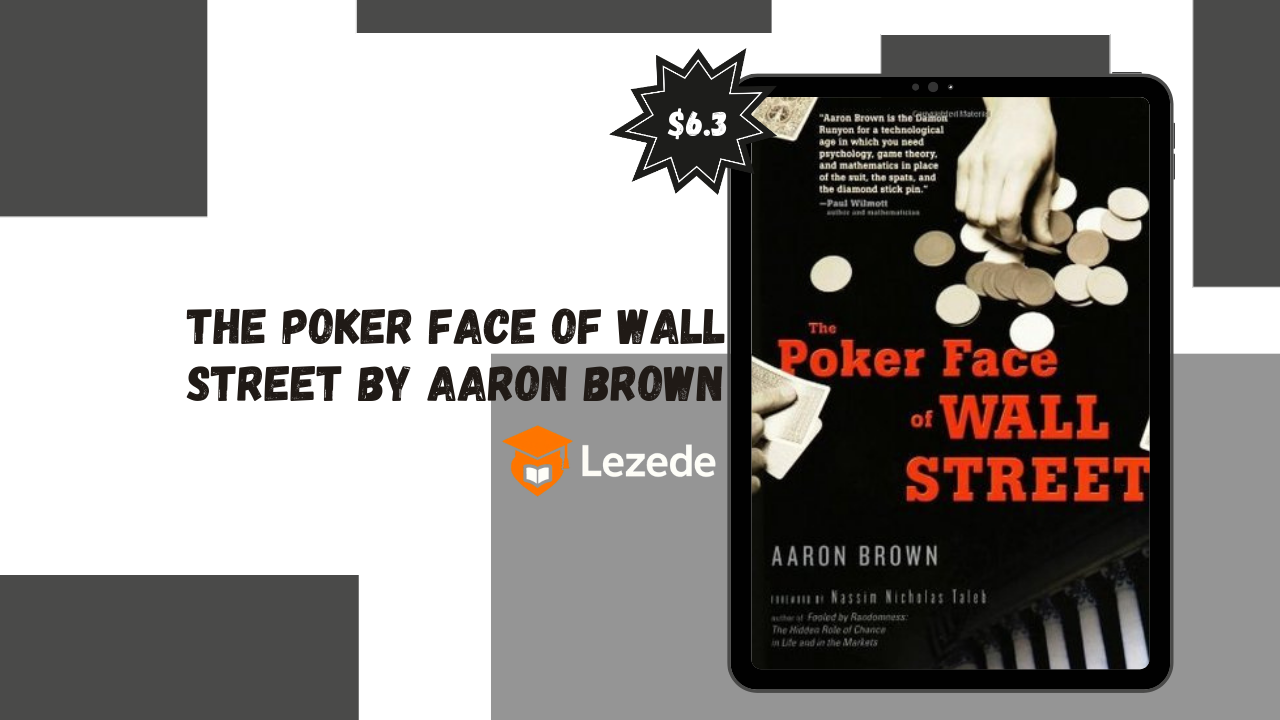
The Poker Face of Wall Street By Aaron Brown – Digital Download!
Introduction to The Poker Face of Wall Street by Aaron Brown
Financial markets often resemble a high-stakes game. Decisions must be made with incomplete information, risk is ever-present, and success depends as much on psychology and probability as on raw data. Few works capture this blend of intellect, nerve, and calculation as effectively as “The Poker Face of Wall Street” by Aaron Brown. Widely respected as a thought-provoking exploration of the similarities between gambling and investing, the book has also inspired seminars and training programs built around its key ideas.
If you’re considering an educational course based on Aaron Brown’s work, you’ll find that it does far more than retell poker stories. It’s a comprehensive look at how risk really works—how to measure it, manage it, and ultimately embrace it as the engine of financial opportunity. This introduction explains the background of the author, the themes of the material, and why its lessons matter to modern investors and traders.
About Aaron Brown
Aaron Brown is a veteran risk manager and quantitative analyst who spent decades inside major financial institutions. He also happens to be an accomplished poker player. This unusual combination gave him a rare perspective: the ability to see financial markets not as rigid systems of formulas but as dynamic games where psychology, probability, and incentives collide.
In The Poker Face of Wall Street, Brown draws on both careers to illustrate how Wall Street and the poker table share a common language of risk, bluffing, and calculated aggression. By grounding abstract finance concepts in vivid examples from gambling, he makes them far more accessible to students, investors, and professionals.
From Book to Course: Turning Insights into Education
Because Brown’s work blends storytelling with quantitative analysis, it lends itself naturally to teaching. Many training programs inspired by The Poker Face of Wall Street—whether corporate workshops or online courses—use its framework to help participants:
-
Understand the true nature of financial risk.
-
See markets as complex adaptive games rather than deterministic machines.
-
Apply concepts from probability, statistics, and behavioral finance to real trading decisions.
The result is an educational experience that is both intellectually rigorous and highly practical.
Core Themes Covered
A course built around The Poker Face of Wall Street typically covers several key themes:
1. Risk as Opportunity
Brown argues that risk is not a hazard to be eliminated but the essential ingredient that makes financial markets possible. Students learn to quantify and price risk instead of simply avoiding it.
2. The Psychology of Bluffing and Signaling
At a poker table, players send and interpret signals—some intentional, some accidental. Markets work the same way. The course explores how to recognize market “bluffs,” avoid being misled by noise, and develop a disciplined response to uncertainty.
3. Probabilities, Odds, and Expected Value
Just as poker players calculate pot odds and expected value, investors must evaluate risk-adjusted returns. The course emphasizes practical ways to apply probability thinking to portfolio management and trading.
4. Risk Management and Capital Allocation
Brown’s insights into position sizing, diversification, and “bankroll” management translate directly from poker to Wall Street. Students learn frameworks for deciding how much to risk on any given trade or investment.
5. Behavioral Pitfalls
Greed, fear, and overconfidence can derail both poker players and investors. A key module examines cognitive biases and teaches strategies for maintaining objectivity under pressure.
Why the Poker Analogy Works
Poker is a game of skill played under conditions of chance. Success requires patience, discipline, and an understanding of human behavior. Financial markets are no different. By framing investment decisions through the lens of poker, Brown strips away jargon and reveals the underlying principles of risk and reward.
For example, folding a marginal hand is like cutting a losing position before it worsens. Making a value bet with a strong hand is analogous to pressing a high-conviction trade. Even the concept of “table selection”—choosing the right game to sit in—translates to picking markets or instruments that match your edge.
Practical Application for Students and Professionals
A course based on The Poker Face of Wall Street doesn’t simply entertain with anecdotes. It shows participants how to:
-
Develop a structured decision-making process under uncertainty.
-
Use simple probability models to guide investment choices.
-
Recognize when risk is being mispriced by the market.
-
Build resilience and mental toughness for high-pressure environments.
Through case studies, simulations, and exercises, learners can practice these skills in a safe setting before applying them to real capital.
Who Should Enroll
Because its lessons cut across disciplines, a training program built on Brown’s book appeals to:
-
Aspiring traders and investors who want a fresh, memorable framework for understanding risk.
-
Financial professionals looking to improve their decision-making and risk assessment skills.
-
Entrepreneurs and executives who face strategic choices with uncertain outcomes.
-
Serious poker players curious about applying their skills to markets.
No advanced math background is required—just a willingness to think probabilistically and challenge conventional wisdom.
The Value of This Perspective in Today’s Market
In an era of algorithmic trading and complex derivatives, it’s easy to forget that markets are ultimately human systems. Fear, greed, and strategic behavior still drive price action, just as they drive decisions at the card table.
Brown’s framework helps demystify this complexity. By treating markets as games of incomplete information, students learn to focus on what they can control: their own risk management, their information gathering, and their psychological discipline. These skills remain valuable whether you’re trading your own account, managing institutional portfolios, or making high-stakes business decisions.
Bridging Theory and Practice
Another strength of courses inspired by The Poker Face of Wall Street is how they blend quantitative and qualitative thinking. Participants might:
-
Work through exercises calculating expected value and variance of returns.
-
Analyze real market scenarios where “bluffing” or signaling played a role.
-
Design personal risk limits and trading plans based on bankroll management concepts.
This hands-on approach turns abstract concepts into practical habits.
Beyond Trading: A Life Skill
Although the course focuses on finance, its lessons have broader relevance. Thinking in terms of probabilities, managing risk, and staying composed under pressure are valuable in any domain—negotiations, entrepreneurship, even personal decisions. Brown’s central message is that learning to “play the game” of risk thoughtfully can improve both your financial results and your overall decision-making.
Conclusion
The Poker Face of Wall Street by Aaron Brown is not just another finance book—it’s a new way of seeing markets and risk. A course built on its principles offers students an engaging, memorable education in how to think like a professional under uncertainty. By combining poker’s lessons in probability, psychology, and discipline with the realities of Wall Street, it equips participants with a practical toolkit for better investing, trading, and risk management.
For anyone ready to move beyond simplistic “safe vs. risky” thinking and embrace the true nature of financial opportunity, learning from Aaron Brown’s insights is a powerful next step.