3 Volatility Strategies By Quantified Strategies Free Download – Includes Verified Content:
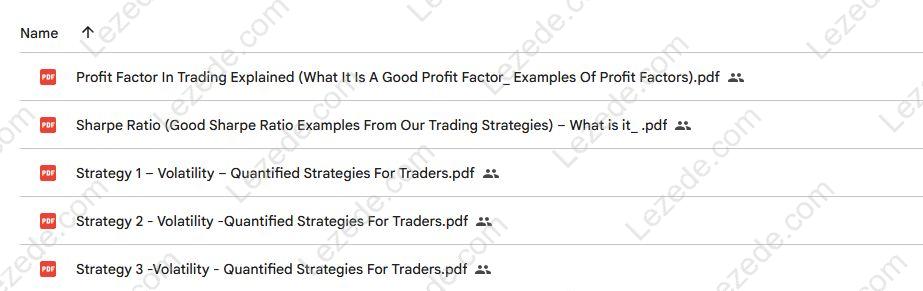
PDF Sample – Profit Factor In Trading Explained (What It Is A Good Profit Factor_ Examples Of Profit Factors), watch here:
In-depth Review of 3 Volatility Strategies by Quantified Strategies
In the ever-shifting world of financial markets, where daily price swings can exceed hundreds of points, mastering volatility and using it to one’s advantage has become essential. Enter the “3 Volatility Strategies” course by Quantified Strategies — an in-depth training program built to give traders the analytical tools and confidence to handle unpredictable market conditions. This program goes beyond surface-level theories, exploring the true mechanics of volatility while teaching hands-on trading techniques suitable for today’s fast-paced environment. Whether you’re a newcomer eager to build a strong foundation or a seasoned trader aiming to refine your edge, this course offers a transformative path into understanding and capitalizing on volatility.
Course Overview and Content
Understanding Volatility
At the heart of the “3 Volatility Strategies” course lies a deep dive into what volatility truly means. This module explains the roots of volatility, its causes, and its critical role in shaping trading opportunities. Through a blend of price action theory and market psychology, learners develop the ability to interpret volatility as a vital element of market structure rather than a threat to avoid.
Volatility is compared to an ocean wave — something to balance with skill rather than fight against. The program uses this metaphor to highlight how traders can navigate sudden market movements by recognizing and anticipating them. Students study real-world case examples demonstrating how rapid fluctuations can be transformed from risks into profit-generating setups.
Rather than treating volatility as a purely academic idea, this section makes it practical. Using historical data and price charts, participants learn how to identify volatility patterns and align their strategies to market sentiment. By the end, traders see volatility as a predictable rhythm they can trade with confidence.
Strategy Application
The next major pillar of the course focuses on applying volatility-based strategies across different markets and instruments. The lessons show traders how to convert volatility from a source of uncertainty into a tactical advantage. Covering both index and commodity markets, this section equips participants with adaptable strategies for changing conditions.
Core strategies include:
-
Mean Reversion: Profiting from the market’s tendency to return to its long-term average, much like a pendulum that swings outward before settling back.
-
Momentum Trading: Learning to identify and follow ongoing trends — riding the wave at its strongest point before it shifts direction.
-
Straddle and Strangle Options: Option techniques designed to capture profits regardless of price direction, emphasizing that volatility can open opportunities on both sides of the market.
This section’s strength lies in its hands-on approach. With live data simulations and practical examples, traders can witness how each strategy behaves under real volatility conditions, ensuring the learning process mirrors genuine market dynamics.
Skills Development
Trading success relies on both knowledge and execution. Recognizing this, the course dedicates a section to developing key technical and analytical skills essential for applying volatility strategies effectively. Participants practice evaluating volatility risk, managing transaction costs, and setting optimal position sizes.
Think of it like constructing a vessel strong enough to weather financial storms — without proper materials and structure (skills), success becomes short-lived.
Key skills developed include:
-
Risk Assessment: Learning to quantify and evaluate risk through tools like the VIX (Volatility Index), a leading measure of market sentiment.
-
Position Sizing: Understanding how to allocate capital efficiently for protection and profitability.
-
Transaction Cost Analysis: Ensuring that execution costs remain minimal, especially when trading in high-volatility conditions.
By mastering these competencies, traders move from passive observers to confident, active participants ready to engage with market uncertainty from a position of strength.

Target Audience
New Traders
The “3 Volatility Strategies” course is ideal for both new and experienced traders. For beginners, it serves as a solid foundation — much like learning the basic rules and techniques before mastering a sport. The structured framework helps new traders build confidence while understanding how volatility shapes the market.
Key benefits for beginners:
-
Clear introduction to how volatility impacts market behavior.
-
Step-by-step trading methods presented in a simple, practical way.
-
Early development of vital trading skills and risk awareness.
Experienced Traders
For advanced traders, the course acts as both a refresher and an upgrade to existing skills. It refines their strategic thinking and helps them adapt to evolving market environments.
Key benefits for seasoned traders:
-
Access to advanced volatility-based systems for improved adaptability.
-
Deeper analytical insights into complex market behavior.
-
Opportunities to connect and share strategies with other experienced traders.
This dual-approach design ensures every participant — regardless of skill level — leaves with actionable insights and a structured system to apply in real trading situations.
Conclusion
In an age dominated by uncertainty, Quantified Strategies’ “3 Volatility Strategies” course stands out as a structured, practical guide for mastering volatile markets. By combining foundational knowledge, strategic applications, and essential skill-building, it provides a holistic learning experience tailored to modern trading challenges.
Those who invest in this program step into the markets as informed strategists, capable of handling volatility with precision and composure. Ultimately, Quantified Strategies delivers a course that not only teaches how to manage market turbulence — it empowers traders to turn volatility into opportunity.