Free Download Event Driven Trading Strategies By QuantInsti
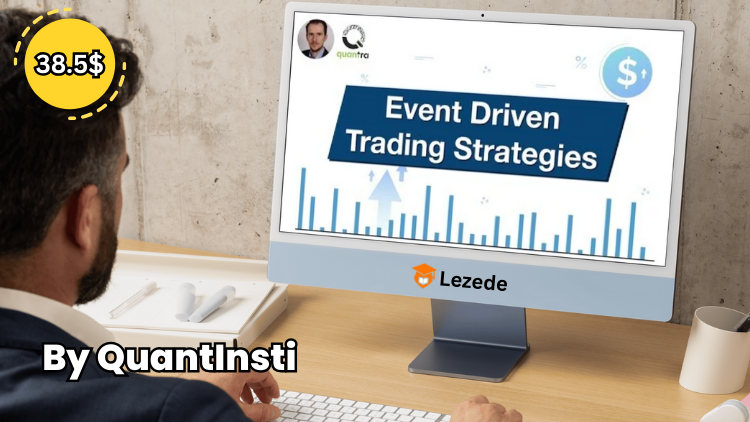
Event Driven Trading Strategies
Develop and test eight seasonal trading systems designed to exploit recurring anomalies across equities, treasuries, and volatility markets. Learn how to draw inspiration from academic research papers to design and refine your own strategies.
LIVE TRADING
-
Build and backtest eight calendar-based anomaly strategies in equity, fixed income, and volatility markets
-
Integrate trend filters to strengthen performance and reduce risk
-
Identify and explain the core fundamental reasons behind these recurring market inefficiencies
-
Combine strategies using inverse volatility weighting and measure overall performance results
-
Apply and evaluate these strategies directly in live markets—no software installation required
SKILLS COVERED
-
Finance & Quantitative Skills: Drawdown, CAGR, Cumulative Returns, Leveraged ETFs
-
Event-Driven Strategies: Turn of the Month, December Effect, Options Expiration Effect, Auction Trading Effect, Fed Day Effect
-
Python Programming: Pandas, NumPy, Matplotlib, Datetime
LEARNING TRACK 1
This course is a part of the Learning Track: Algorithmic Trading for Beginners
PREREQUISITES
This course requires a basic understanding of financial markets such as different asset classes, ETFs and order and trade execution. The concepts covered in this course can be learned without programming knowledge. If you want to implement the strategies covered, the basic knowledge of “pandas dataframe” and “matplotlib” is required. The required skills are covered in the “Python for Trading: Basic” free course on Quantra.
SYLLABUS
Introduction to the Course
An event driven trading strategy systematically seeks to recognise and exploit patterns in the financial market. In this section, we will talk about event driven trading strategy, the importance of algorithmic trading research papers, and how to use these papers to create trading models.
- Prologue 5m 30s
- Course Structure 2m 13s
- Quantra Features and Guidance 3m 48s
Introduction to Event Trading Strategies
In the section, you will learn about event driven trading strategies in detail and its underlying reason. The strategy is applied only when there is a fundamental reason for the pattern and not a random coincidence. You will also learn about the advantages of event driven strategies and how an event which is known beforehand can be used to maximise gains.
- Seasonal Event-driven Trading Strategies 2m 35s
- Describing Seasonal/Calendar Trading Strategy 2m
- Advantage of Seasonal/Calendar Strategy 2m
- Theory Behind Event-driven Trading Strategies 2m 40s
- Fundamental Reasons Behind Calendar Anomalies 2m
Turn of Month Effect in Equities
We start with one of the most common calendar anomalies in the equity markets that is the turn of the month. At the end of the month, some recognisable pattern has been observed in the equity markets. In this section, you will learn the fundamental reason behind this pattern and how to exploit this information in creating a simple trading strategy.
- Precap of Calendar Anomalies in Equities 43s
- Exchange Traded Fund 10m
- ETF Definition 2m
- SPY ETF 2m
- Trading ETFs 2m
- Turn of Months Effect 3m 50s
- Reason for Turn of the Month 2m
- Trading Rules for ToM 2m
- Motivation for Trend-Following Filter 2m
- Test on Turn of Month Effect in Equities 14m
Turn of Month Effect in Equities Code
This is a practice section that teaches you in a step by step manner, to implement the turn of the month trading strategy in Python. You will learn to read data, generate trading signals and analyse strategy performance of the strategy. You will also practice these codes in an easy to follow, interactive coding environment.
- How to Use Jupyter Notebook? 2m 5s
- Turn of the Month Code 10m
- Frequently Asked Questions 10m
- Read Data From CSV 5m
- Calculate Daily SPY Returns 5m
- Generate Turn of the Month Signal 5m
- Calculate Strategy Returns 5m
- Calculate Cumulative Returns 5m
- Plot Cumulative Curve 5m
- Calculate Running Maximum Value 5m
- Calculate Drawdown 5m
- Calculate the Rolling Mean 5m
- Generate SMA Signal 5m
- Strategy Returns With Trend Factor 5m
- Turn of the Month Effect Additional Reading 10m
Live Trading on Blueshift
This section will walk you through the steps involved in taking your trading strategy live. You will learn about backtesting and live trading platform, Blueshift. You will learn about code structure, various functions used to create a strategy and finally, paper or live trade on Blueshift.
- Section Overview 2m 19s
- Live Trading Overview 2m 41s
- Vectorised vs Event Driven 2m
- Process in Live Trading 2m
- Real-Time Data Source 2m
- Blueshift Code Structure 2m 57s
- Important API Methods 10m
- Schedule Strategy Logic 2m
- Fetch Historical Data 2m
- Place Orders 2m
- Backtest and Live Trade on Blueshift 4m 5s
- Additional Reading 10m
- Blueshift Data FAQs 10m
Live Trading Template
Blueshift Live Trading Template
- Paper/Live Trading Turn of Month Strategy 10m
- FAQs for Live Trading on Blueshift 10m
Payday Effect in Equities
The payday effect is similar to the turn of the month effect. It has been observed that the 16th day of the month is the most profitable day in a month, which leads to a trading strategy. In the section, you will learn the reason behind this effect, backtest the payday effect strategy and analyse the performance of the strategy.
- Payday Effect 2m 47s
- Reason for Payday Drift 2m
- Rules for Payday Effect Strategy 2m
- Payday Effect Code 10m
- Find 16th Day of the Month 5m
- Paper/Live Trading Payday Effect Strategy 10m
- Payday Effect Additional Reading 10m
FED Day Effect in Equities
Federal Open Market Committee Meetings occur eight times per year and dates are well-known. There is some positive drift in the stock prices during these meetings. In the section, you will learn the reason behind this and create a trading strategy around that.
- FED Day Effect 4m 32s
- Trading the FED Day Strategy 2m
- Reason for Market Drift During FOMC 2m
- FED Trend-Following Filter 2m
- FED Day Effect Code 10m
- Fed Meeting Date in the SPY Trading Date 5m
- FED Day Effect Additional Reading 10m
Options Expiration Effect in Equities
During options expiration week, there is some unusual pattern observed in the equity markets, which leads to another calendar anomaly strategy. You will learn the reason behind this effect and create a trading strategy based on this effect.
- Options Expiration Effect 4m 17s
- Trading Rules for Options Expiration Strategy 2m
- Options Expiration Week Market Drift 2m
- Equity Segment in Options Expiration 2m
- Options Expiration Effect Code 10m
- Calculate Min Year Value in SPY Data 5m
- Paper/Live Trading Options Expiration Effect Strategy 10m
- Options Expiration Effect Additional Reading 10m
- Test on Payday Effect, FED Day Effect and Options Expiration Effect 14m
Auction Trading Effect in Fixed Income
Treasury prices fall for a brief period of time right before the dates of treasury bond auctions by governments. In this section, you will learn how to use this fall in price to create a profitable seasonal trading strategy. You will also be implementing it in Python.
- Fixed Income Government Bonds 10m
- Government Bond Risk 2m
- Government Bonds Trading 2m
- Auction Trading Effect 4m 1s
- Definition of Treasury Auction 2m
- Treasury Bond Price Patterns 2m
- Market Drift During Treasury Auction 2m
- Auction Trading Effect Code 10m
- Comparison of Treasury Date With Auction Date 5m
- Implementation of Treasury Auction Conditions 2m
- Auction Effect Additional Reading 10m
End of the Month Effect in Fixed Income
Fixed income bonds like the government bonds show statistically significant positive returns at the end of the month. This is seen particularly in bonds with longer maturity periods. This is just like in effect in equities handled in the sections before. In this section, you learn to use fixed-income ETFs to create month-end strategies to exploit this effect.
- End of the Month Effect 3m 34s
- Market Segment for EOM Effect 2m
- Trading Rules for EOM Effect 2m
- Reason for Drift During EOM 2m
- End of the Month 10m
- Condition for Last Day of the Month 5m
- End of Month Effect Additional Reading 10m
- Test on Auction Trading Effect and End of the Month Effect 14m
Calendar Effect in Volatility Market
VIX index is a measure of perceived volatility in the market. VIX futures are traded in the market and they expire every month. We see a seasonal pattern of returns around the time of expiration which is statistically significant. In this section, you will use VIXY to implement a strategy in Python, which exploits this pattern. You will also learn ways to enhance this strategy.
- Concepts of Volatility Markets 10m
- VIX Futures Expiration Effect 2m 14s
- Instrument in Volatility Strategy 2m
- VIX Expiration Effect Rules 2m
- VIX Expiration Effect Drift 2m
- VIX Futures Expiration Strategy 10m
- Comparison of VIXY Date With Expiration Date 5m
- VIX Futures Expiration Enhancement 4m 35s
- Risk of Short Volatility Position 2m
- Meaning of Contango 2m
- Enhanced VIX Futures Strategy Rules 2m
- VIX Futures Expiration Enhanced Strategy 10m
- Comparison of VIX3M Price With VIX1M Price 5m
- VIX Futures Expiration Additional Reading 10m
December Effect in Volatility Market
The sentiments in the market around the holiday season in December, in general, are high. The liquidity is low. This leads to a positive trend around the time of Christmas. In this section, you will learn more about this and learn what historical data says about returns around this time. You will create a strategy in Python to exploit this seasonal occurrence. You will also learn ways to enhance the performance of your strategy using long-term VIX futures filters.
- December Seasonality Effect 3m 2s
- December Volatility Effect Trading Rules 2m
- Reason for December Volatility Drift 2m
- December Seasonality Effect 10m
- Flagging December Expirations 5m
- Flag Post Christmas Business Days 5m
- Type of Merge 2m
- December Effect Additional Reading 10m
- Test on Calendar Effect and December Effect 14m
Composite Strategy
In the sections, before this, you saw strategies made on equity, fixed-income and volatility instruments. In this section, you will learn multiple ways to combine these strategies to build a portfolio of strategies. The motivation is to use cash better and to create a single composite strategy which outperforms individual strategies. You will implement multiple ways to do this in Python.
- Introduction to Composite Seasonal Strategy 2m 1s
- Composite Strategy – Equal Weighted 1m 47s
- Composite Strategy – Volatility Weighted 3m 15s
- Inverse-volatility Weighting Approach 2m
- Methodology of Composite Strategy 2m
- Composite Strategy – Enhanced Volatility 2m 8s
- Improving Composite Seasonal Strategy 2m
- Composite Strategy 10m
- Combining SPY Signals Using Max 5m
- Calculating Weighted Cumulative Returns 5m
Composite Strategy Enhancement
In this section, you will learn about how to enhance the composite strategies you developed in the previous sections. You will also go beyond the experiments and learn about the impact of trading costs and slippages on the profitability of the composite strategy you created.
- Effect of Trading Cost 2m 24s
- Calculate the Trading Cost 2m
- Calculate the Slippage 2m
- Composite Strategy Improvement 1m 21s
- Advantage of a Multi-strategy Portfolio 2m
Effect of COVID-19
This section includes the effect of coronavirus pandemic on the overall market. And its impact on the performance of the composite strategy.
- Effect of COVID-19 3m 4s
- Movement of SPY and VIXY 2m
- Effect on Composite Strategy 2m
- Test on Composite Strategy and Effect of COVID-19 14m
Automate Trading Strategies
This section deals with the steps required to automate the trading strategy for real trading using a broker’s account. You will learn step by step guide to connect your trading strategy with the broker’s account, fetch real & historical data, and place orders.
- Automation of Strategy 10m
- Paper/Live Trading Turn of Month Strategy (IBridgePy) 2m
- Tasks Required for Live Trading 2m
- Application Programming Interface 2m
- Connect Python IDE’s to Broker’s Terminal 2m
Run Codes Locally on Your Machine
- Learn to install the Python environment in your local machine.
- Python Installation Overview 1m 59s
- Flow Diagram 10m
- Install Anaconda on Windows 10m
- Install Anaconda on Mac 10m
- Know your Current Environment 2m
- Troubleshooting Anaconda Installation Problems 10m
- Creating a Python Environment 10m
- Changing Environments 2m
- Quantra Environment 2m
- Troubleshooting Tips For Setting Up Environment 10m
- How to Run Files in Downloadable Section? 10m
- Troubleshooting For Running Files in Downloadable Section 10m
Course Summary
- This section includes a course summary and downloadable zipped folder with all the codes and notebooks for easy access.
- Course Summary 3m 36s
- Python Codes and Data 2m
ABOUT THE AUTHOR
Quantpedia
The database and encyclopedia of quantitative and algorithmic trading strategies is called Quantpedia. It assists users in converting scholarly financial research into a more approachable format to assist anyone looking for fresh concepts for quantitative trading strategies.
QUANTRA®: WHY?
- Get more in less time.
- Learn from professionals
- Study at your own speed.
- Obtain data and approach models for self-practice.
REVIEWS
SHALINI MEHER Singapore Codes are helpful and strategies are clearly stated. To ensure the learner understands every step of the process, the course also explains the rationale behind the code’s creation and how it will function.
EDWARD HASENKAMP, Netherlands, Software Security Expert
The way the concepts were presented in the video sections was excellent, and the course is well-structured. I’ve been able to study market fluctuations thanks to it. The Jupyter notebook integration was fantastic because it lets me experiment with the coding while I’m on the go. When I first started, I would download the codes from the PDFs and try them out on my computer. However, now that I have this integrated notebook, the entire process of practically learning has become easy and hassle-free. All things considered, the way the courses are presented and designed has made “learning” enjoyable.