Regression Diagnostics: Identifying Influential Data and Sources of Collinearity By David Belsey, Edwin Kuh & Roy Welsch – Digital Download!
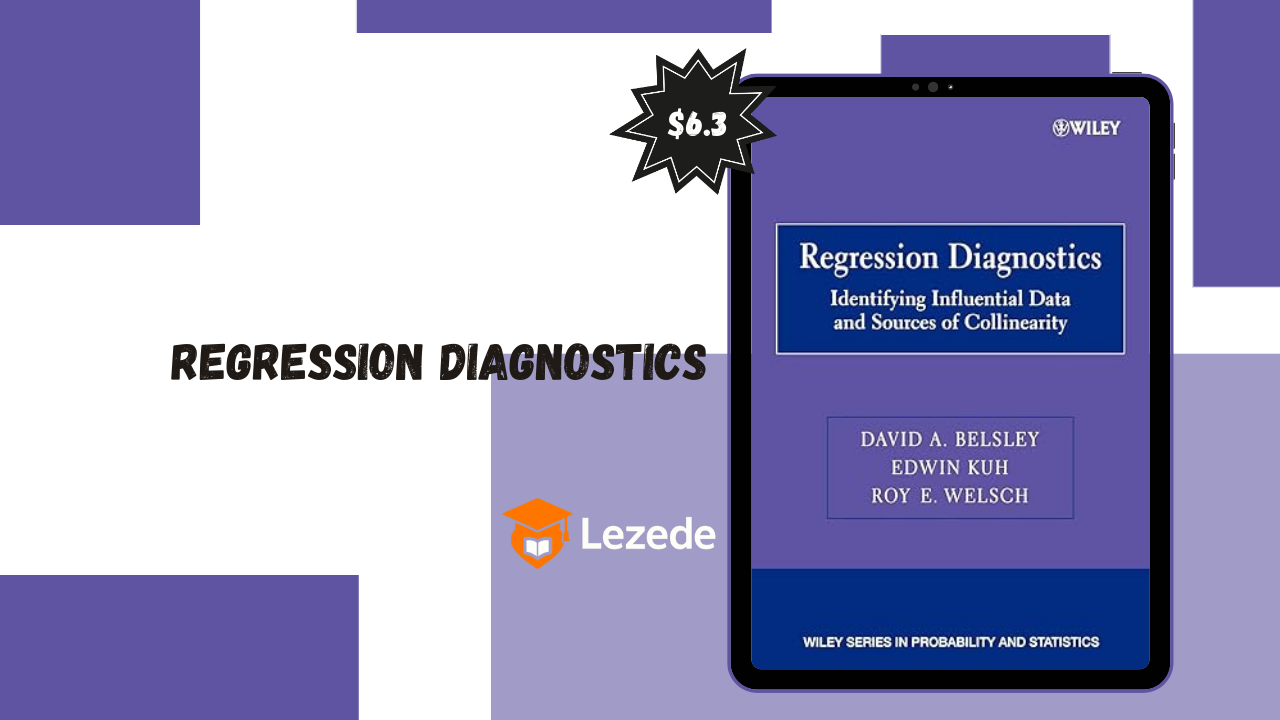
Introduction to Regression Diagnostics: Identifying Influential Data and Sources of Collinearity
In the world of statistical analysis, regression models are among the most powerful tools available for understanding the relationships between variables, making predictions, and guiding decision-making across numerous fields such as finance, economics, healthcare, engineering, and social sciences. Yet, the utility of these models is highly contingent on their accuracy and reliability. Even a well-formulated regression model can produce misleading or incorrect conclusions if the underlying data contains anomalies, influential points, or multicollinearity among predictors. Recognizing these potential pitfalls is essential for anyone seeking to apply regression analysis rigorously. This is precisely the focus of the course “Regression Diagnostics: Identifying Influential Data and Sources of Collinearity”, authored by eminent statisticians David Belsey, Edwin Kuh, and Roy Welsch.
This course delves deeply into regression diagnostics, a specialized branch of statistical methodology that emphasizes the identification and evaluation of influential data points, detection of outliers, and assessment of multicollinearity. While traditional regression analysis often assumes that the data is “well-behaved,” real-world datasets rarely conform perfectly to these assumptions. Unaddressed, these issues can significantly distort estimates, reduce predictive accuracy, and lead to erroneous interpretations. This course provides both a theoretical framework and practical techniques to recognize and mitigate such problems, enabling students and professionals to enhance the robustness and credibility of their regression models.
Understanding Influential Data Points
One of the central themes of this course is the concept of influential data points. In regression analysis, not all observations contribute equally to the estimation of model parameters. Some data points, often referred to as “leverage points” or “influential observations,” can disproportionately affect the results of a regression model. A single extreme value can skew coefficient estimates, alter the direction of relationships, or inflate standard errors. Identifying these influential points is critical, as ignoring them can lead to models that misrepresent the underlying relationships between variables.
The course introduces students to a variety of diagnostic measures, such as Cook’s Distance, DFFITS, leverage values, and studentized residuals, which are designed to quantify the influence of individual data points. Through detailed explanations and practical examples, learners gain the ability to distinguish between ordinary variability and true influence, empowering them to make informed decisions about data treatment—whether that involves further investigation, transformation, or exclusion of problematic observations.
Detecting Outliers and Anomalies
Closely related to influential points is the concept of outliers. Outliers are data points that deviate markedly from the overall pattern of the dataset. While some outliers may represent genuine phenomena worthy of further study, others can be the result of data entry errors, measurement inaccuracies, or other anomalies that distort model estimates. This course equips participants with robust techniques for detecting outliers, including residual analysis, standardized residuals, and visual inspection methods such as scatterplots and influence plots.
Moreover, the course emphasizes the importance of context when evaluating outliers. Not all extreme observations are harmful; in fact, they can provide critical insights into the underlying processes. Students learn how to differentiate between influential observations that reveal meaningful trends and those that compromise the integrity of the regression model. This nuanced approach ensures that learners are not merely applying mechanical diagnostics but are engaging in thoughtful, data-driven decision-making.
Understanding and Addressing Collinearity
Another critical topic addressed in this course is multicollinearity, which occurs when two or more predictor variables in a regression model are highly correlated. Multicollinearity can inflate the variance of coefficient estimates, making it difficult to determine the individual effect of each predictor. This problem can lead to unstable models, counterintuitive coefficient signs, and misleading interpretations.
The course explores both the detection and management of collinearity. Participants learn how to quantify multicollinearity using metrics such as Variance Inflation Factor (VIF) and condition indices, and how to interpret these measures to assess model reliability. In addition, the course presents practical strategies for mitigating multicollinearity, including variable selection, transformation, and principal component analysis. By combining theoretical insights with actionable techniques, learners are equipped to construct more reliable and interpretable regression models.
Practical Applications and Real-World Relevance
A distinguishing feature of Regression Diagnostics is its emphasis on practical application. Throughout the course, students are exposed to real-world datasets from a variety of disciplines, illustrating how regression diagnostics can inform better decision-making and improve model performance. Whether analyzing economic indicators, clinical trial data, market trends, or social science surveys, the principles taught in this course have broad applicability.
By engaging with practical examples, learners develop the ability to implement diagnostic procedures, interpret results, and apply corrective measures in a systematic and rigorous manner. This hands-on approach not only reinforces theoretical understanding but also ensures that students can translate their knowledge into actionable insights in professional settings.
Learning Outcomes and Skills Development
Upon completing this course, participants will be able to:
-
Identify influential data points and assess their impact on regression models.
-
Detect and evaluate outliers, understanding when they reflect genuine phenomena versus data anomalies.
-
Diagnose multicollinearity and implement strategies to address it.
-
Apply diagnostic measures such as Cook’s Distance, leverage values, DFFITS, and VIF.
-
Enhance the accuracy, stability, and interpretability of regression models across diverse applications.
The skills acquired in this course are invaluable for statisticians, data analysts, economists, researchers, and anyone who relies on regression analysis to inform decisions. By mastering regression diagnostics, participants can improve the robustness of their models, make more reliable predictions, and ensure that their findings reflect true relationships rather than artifacts of the data.
Instructor Expertise
The authors of this course—David Belsey, Edwin Kuh, and Roy Welsch—are highly respected figures in the field of statistics. Their extensive research and practical experience provide a strong foundation for the course content. The combination of their expertise ensures that learners receive instruction that is both rigorous and grounded in real-world application, bridging the gap between theoretical concepts and practical utility.
Conclusion
In summary, Regression Diagnostics: Identifying Influential Data and Sources of Collinearity is an essential course for anyone seeking to enhance their understanding of regression analysis. By focusing on influential data points, outliers, and multicollinearity, this course equips learners with the knowledge and tools necessary to construct reliable and insightful regression models. The practical orientation, combined with the guidance of expert instructors, ensures that participants gain both the theoretical understanding and the hands-on experience required to navigate the complexities of real-world data.
For those serious about improving their statistical modeling skills, mastering regression diagnostics is not optional—it is critical. This course provides the foundation and expertise needed to recognize, evaluate, and address the common pitfalls that can compromise regression analyses, ultimately empowering learners to make better data-driven decisions and achieve more accurate, trustworthy results.