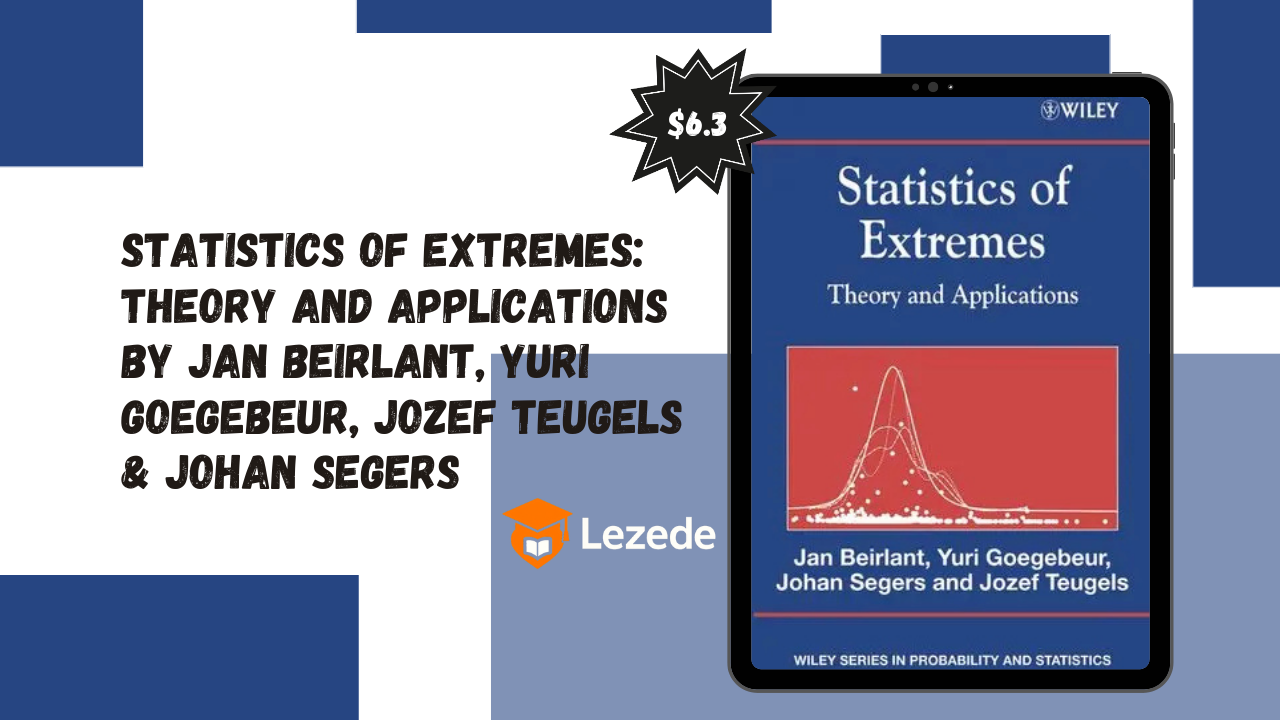
Statistics of Extremes: Theory and Applications By Jan Beirlant, Yuri Goegebeur, Jozef Teugels & Johan Segers – Instant Download!
Introduction
In today’s data-driven world, understanding rare yet impactful events is no longer optional—it is essential. The course “Statistics of Extremes: Theory and Applications” offers a comprehensive journey into the principles and methods used to analyze extreme values across diverse disciplines. Developed by renowned statisticians Jan Beirlant, Yuri Goegebeur, Jozef Teugels, and Johan Segers, this course brings together decades of academic expertise and practical insights to equip learners with the tools to tackle complex problems involving extreme phenomena.
This program focuses on the foundations of extreme value theory, starting with the mathematical underpinnings that describe the behavior of rare events and progressing toward real-world applications. Students will explore the statistical models that quantify risk in situations where conventional methods fail—such as catastrophic environmental events, financial market crashes, insurance claims, or engineering system failures. By blending theory with hands-on case studies, the course enables participants to translate abstract concepts into actionable analyses.
Whether you are a statistician, data scientist, risk analyst, or researcher, “Statistics of Extremes” is designed to broaden your perspective on how extremes shape our understanding of uncertainty. The instructors place a strong emphasis on practical application, guiding learners through the use of specialized techniques for estimating probabilities, modeling tail distributions, and making predictions beyond observed data.
By the end of this course, participants will not only have a firm grasp of the theoretical framework but also the confidence to implement extreme value methods in their own fields. This balanced approach makes “Statistics of Extremes: Theory and Applications” a vital resource for anyone seeking to master the art and science of analyzing rare yet highly consequential events.
TABLE OF CONTENTS
Preface.
1 WHY EXTREME VALUE THEORY?
1.1 A Simple Extreme Value Problem.
1.2 Graphical Tools for Data Analysis.
1.3 Domains of Applications.
1.4 Conclusion.
2 THE PROBABILISTIC SIDE OF EXTREME VALUE THEORY.
2.1 The Possible Limits.
2.2 An Example.
2.3 The Fr’echet-Pareto Case: ³ > 0.
2.4 The (Extremal) Weibull Case: ³ 0.
2.5 The Gumbel Case: ³ = 0.
2.6 Alternative Conditions for (C³ ).
2.7 Further on the Historical Approach.
2.8 Summary.
2.9 Background Information.
3 AWAY FROM THE MAXIMUM.
3.1 Introduction.
3.2 Order Statistics Close to the Maximum.
3.3 Second-order Theory.
3.4 Mathematical Derivations.
4 TAIL ESTIMATION UNDER PARETO-TYPE MODELS.
4.1 A Naive Approach.
4.2 The Hill Estimator.
4.3 Other Regression Estimators.
4.4 A Representation for Log-spacings and Asymptotic Results.
4.5 Reducing the Bias.
4.6 Extreme Quantiles and Small Exceedance Probabilities.
4.7 Adaptive Selection of the Tail Sample Fraction.
5 TAIL ESTIMATION FOR ALL DOMAINS OF ATTRACTION.
5.1 The Method of Block Maxima.
5.2 Quantile View–Methods Based on (C³).
5.3 Tail Probability View–Peaks-Over-Threshold Method.
5.4 Estimators Based on an Exponential Regression Model.
5.5 Extreme Tail Probability, Large Quantile and Endpoint Estimation Using Threshold Methods.
5.6 Asymptotic Results Under (C³ )-(C*³ ).
5.7 Reducing the Bias.
5.8 Adaptive Selection of the Tail Sample Fraction.
5.9 Appendices.
6 CASE STUDIES.
6.1 The Condroz Data.
6.2 The Secura Belgian Re Data.
6.3 Earthquake Data.
7 REGRESSION ANALYSIS.
7.1 Introduction.
7.2 The Method of Block Maxima.
7.3 The Quantile View–Methods Based on Exponential Regression Models.
7.4 The Tail Probability View–Peaks Over Threshold (POT) Method.
7.5 Non-parametric Estimation.
7.6 Case Study.
8 MULTIVARIATE EXTREME VALUE THEORY.
8.1 Introduction.
8.2 Multivariate Extreme Value Distributions.
8.3 The Domain of Attraction.
8.4 Additional Topics.
8.5 Summary.
8.6 Appendix.
9 STATISTICS OF MULTIVARIATE EXTREMES.
9.1 Introduction.
9.2 Parametric Models.
9.3 Component-wise Maxima.
9.4 Excesses over a Threshold.
9.5 Asymptotic Independence.
9.6 Additional Topics.
9.7 Summary.
10 EXTREMES OF STATIONARY TIME SERIES.
10.1 Introduction.
10.2 The Sample Maximum.
10.3 Point-Process Models.
10.4 Markov-Chain Models.
10.5 Multivariate Stationary Processes.
10.6 Additional Topics.
11 BAYESIAN METHODOLOGY IN EXTREME VALUE STATISTICS.
11.1 Introduction.
11.2 The Bayes Approach.
11.3 Prior Elicitation.
11.4 Bayesian Computation.
11.5 Univariate Inference.
11.6 An Environmental Application.