Transforms and Applications Handbook (2nd Edition) By Alexander Poularikas – Digital Download!
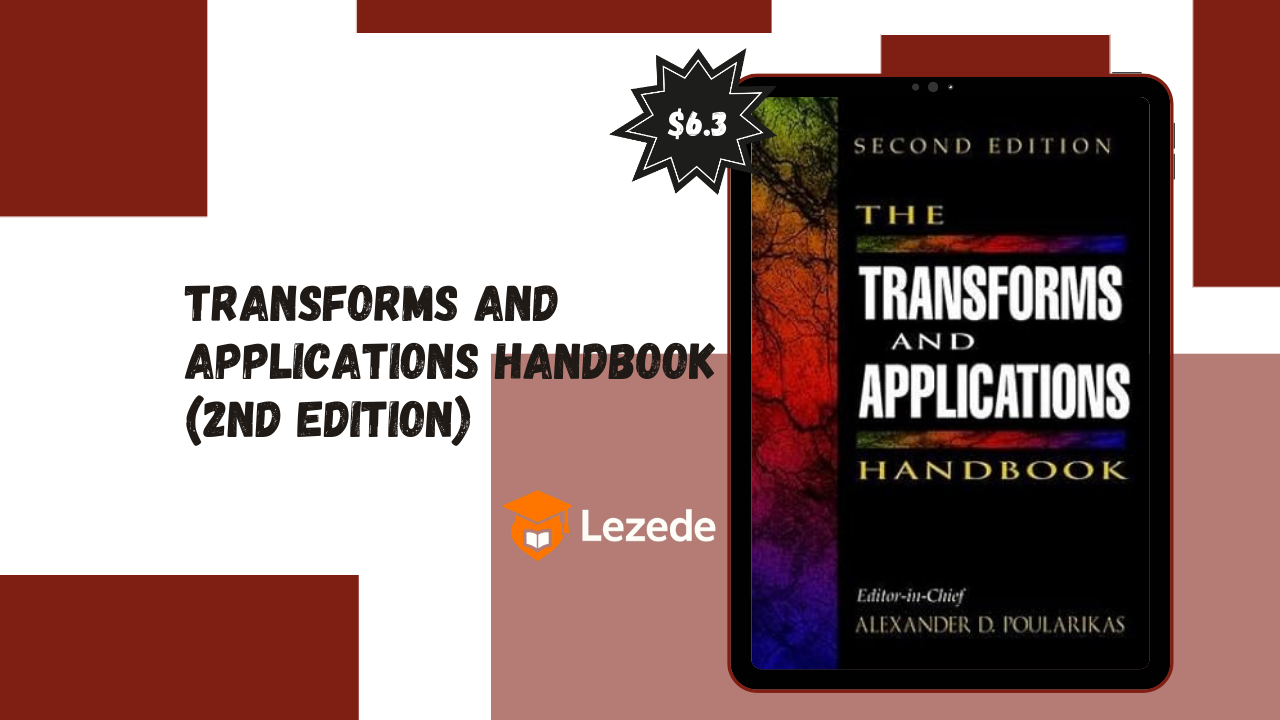
Introduction to Transforms and Applications Handbook (2nd Edition) by Alexander Poularikas
From signal processing and control systems to communications and image analysis, transform techniques form the backbone of modern engineering and applied mathematics. They provide a systematic way to convert difficult problems into forms that are easier to solve—often turning differential equations into algebraic ones or revealing hidden structures within complex data.
The “Transforms and Applications Handbook (2nd Edition)” by Alexander Poularikas serves as a comprehensive guide to these powerful tools. Written by a respected educator and researcher, the handbook consolidates an extensive range of transform methods and illustrates their practical applications across diverse engineering disciplines. For students, professionals, and researchers alike, it functions not merely as a reference but as a structured learning resource.
About the Author
Alexander D. Poularikas is a well-known figure in electrical engineering and applied mathematics. With decades of teaching experience and numerous publications, he has dedicated his career to making complex analytical tools accessible to practicing engineers and graduate students. His ability to present abstract concepts in a clear, example-driven manner makes the Transforms and Applications Handbook an essential text for anyone serious about mastering transform techniques.
Why Study Transforms?
At its core, a transform is a mathematical operation that re-expresses a function or signal in a different domain. Some common examples:
-
The Laplace transform, which simplifies analysis of linear time-invariant systems.
-
The Fourier transform, which reveals a signal’s frequency components.
-
The Z-transform, widely used in digital signal processing.
-
The Hilbert, Mellin, and Wavelet transforms, which address specialized problems in communications, imaging, and pattern recognition.
Learning transforms equips engineers and scientists to:
-
Analyze complex systems more efficiently.
-
Design filters and controllers.
-
Understand spectral content and time-frequency behavior of signals.
-
Solve partial differential equations arising in physics and engineering.
Poularikas’s handbook brings all these techniques under one roof, emphasizing not only the mathematics but also their real-world utility.
Scope and Structure of the Handbook
The second edition expands and updates the material of the first edition to reflect contemporary practices. While each chapter can stand on its own as a reference, the text is organized in a progression that facilitates learning:
1. Fundamental Concepts
An overview of basic mathematical operations, integral transforms, and the properties that different transforms share, such as linearity, convolution, and shift theorems.
2. Classical Transforms
Detailed coverage of the Fourier, Laplace, Z-, and Hilbert transforms, including definitions, inversion formulas, properties, and illustrative examples drawn from engineering contexts.
3. Advanced and Specialized Transforms
Presentation of the Mellin, Hankel, Radon, and Wavelet transforms, showing how these tools solve particular classes of problems in imaging, pattern analysis, and multidimensional systems.
4. Applications in Engineering and Science
Case studies and worked examples demonstrating how transform techniques are applied in communications, control, vibration analysis, optics, probability theory, and beyond.
5. Tables and Computational Aids
Extensive tables of transform pairs and properties, along with guidance on numerical implementation using modern software packages.
This structure allows readers to either browse for a specific transform or work through the material sequentially like a course.
Pedagogical Features
Although it is called a “handbook,” the second edition has several learning-friendly features:
-
Clear definitions and theorems presented up front, followed by proofs or intuitive explanations.
-
Step-by-step worked examples that show how to move from a real-world problem to a transformed solution and back again.
-
Exercises and references at the end of sections to encourage deeper exploration.
-
Tables and diagrams that summarize key properties and relationships between transforms.
These elements make it suitable not just for quick consultation but also for structured self-study.
Applications Highlighted in the Text
One of the strengths of Poularikas’s approach is his emphasis on applications. Readers encounter how transform methods are used in:
-
Signal Processing – filtering, spectral estimation, and system identification.
-
Control Engineering – stability analysis, transient response, and controller design using Laplace and Z-transforms.
-
Communications – modulation analysis, channel characterization, and coding.
-
Image and Data Analysis – edge detection, pattern recognition, and tomography using Radon and Wavelet transforms.
-
Physics and Applied Mathematics – solving boundary-value problems, heat and wave equations, and stochastic processes.
By grounding abstract techniques in real scenarios, the handbook bridges the gap between theory and practice.
Who Should Use This Handbook
The text is aimed at multiple audiences:
-
Undergraduate and graduate students in electrical engineering, applied mathematics, and physics who need a single, authoritative source on transform methods.
-
Practicing engineers and scientists who want a reliable reference for solving day-to-day problems.
-
Researchers exploring new transform-based approaches in emerging fields like biomedical imaging or machine learning.
Its breadth makes it equally valuable in academia and industry.
Key Advantages of the Second Edition
Compared with earlier editions and other references, the second edition offers:
-
Updated content reflecting advances in digital signal processing and new transform techniques.
-
Expanded application sections linking theory to current engineering challenges.
-
Improved organization and indexing for faster lookup of formulas and properties.
-
Consistency of notation across different transforms, reducing confusion when switching between chapters.
These improvements enhance its utility as both a teaching tool and a working reference.
Learning Outcomes from Using the Handbook as a Course Text
Approaching the handbook like a course yields several benefits:
-
Conceptual Mastery – Understanding the underlying principles common to all transforms.
-
Problem-Solving Skills – Applying the right transform to simplify and solve complex equations.
-
Computational Proficiency – Implementing transforms numerically and interpreting results correctly.
-
Cross-Disciplinary Insight – Seeing how the same mathematical tool applies across communications, control, and physics.
By the end of such a learning journey, readers are not only familiar with individual transforms but also skilled at selecting and adapting them to new challenges.
Relevance in Today’s Engineering Landscape
In an era of big data, advanced sensors, and high-speed computation, transform techniques remain indispensable. Whether designing a digital filter, analyzing vibrations in an aircraft wing, or reconstructing an image from partial measurements, engineers rely on transforms to extract meaning from complexity. Poularikas’s Transforms and Applications Handbook equips them with a unified and updated toolkit to meet these demands.
Conclusion
The “Transforms and Applications Handbook (2nd Edition)” by Alexander Poularikas is more than a compilation of formulas; it’s a comprehensive roadmap to understanding and applying transform techniques across engineering and science. By presenting classical and modern transforms alongside their practical applications, the book empowers readers to approach complex problems with confidence and precision.
For students seeking a structured learning resource, for professionals needing a quick yet authoritative reference, or for researchers exploring new frontiers, this handbook stands as an essential companion in the field of applied mathematics and engineering analysis.